LOGIK//CORE — UTN entrance exam simulator
A single-page app with a spy-terminal aesthetic to train for the pseudocode final evaluation of the UTN entrance course.
- HTML
- CSS
- JavaScript
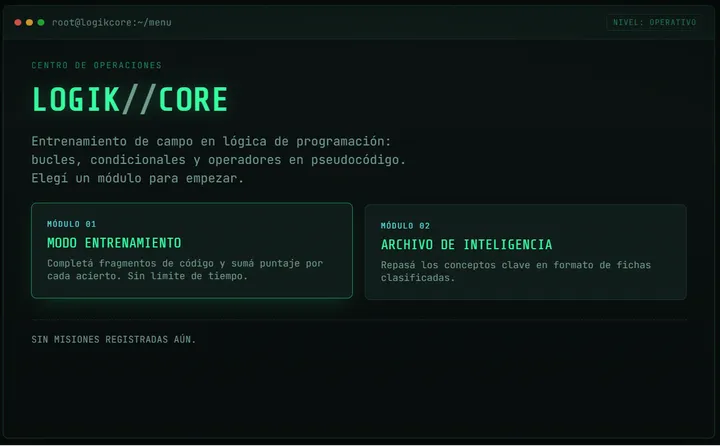
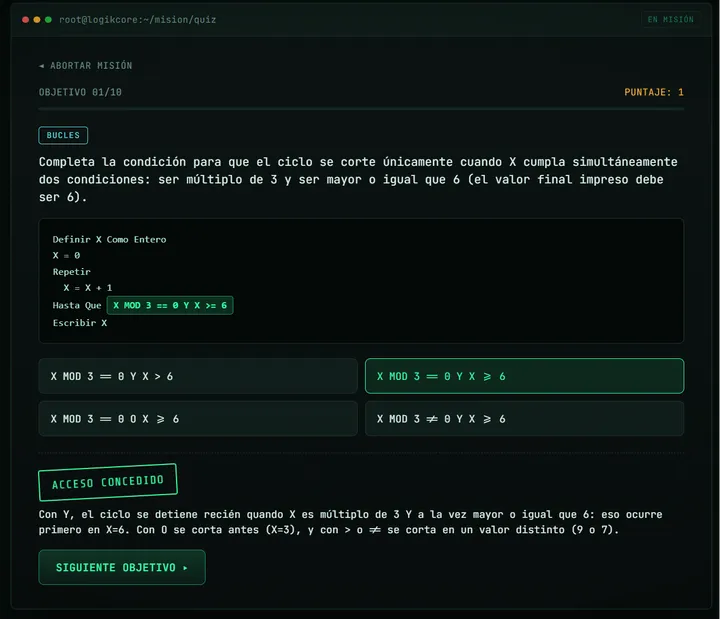
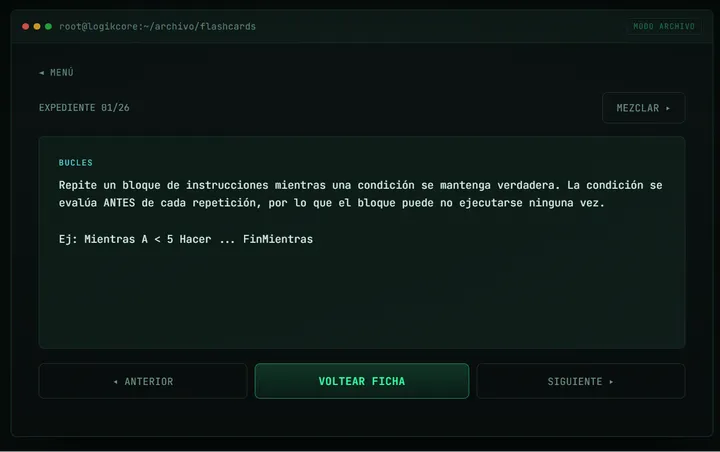
What it is
A single-page app (HTML + CSS + JS, no dependencies, no build step) to practice for the pseudocode final evaluation of the UTN entrance course (TUPad). I built it with a spy-terminal look — green phosphor, CRT texture, code-named categories, an “Intelligence File” for the flashcards section — so studying before the exam feels less like re-reading a PDF and more like training for a mission.
What it does
- Training mode: a quiz configurable by number of exercises and categories (loops, conditionals, operators, general theory), with feedback and an explanation on every answer.
- Two question types: complete/predict the output of a pseudocode snippet, or answer a theory question.
- Intelligence File: quick-review flashcards for control structures, operators, and common patterns (counter, accumulator).
- A bank of 30+ questions, based on my own attempts at UTN’s real practice exam (with a few contributions from classmates).
What I learned / solved
- All the pedagogical content is my own work: which questions to include, which exam they come from, what concepts they cover, and how to group them into categories so the review actually maps onto the real exam.
- I built the interface and logic with Claude’s assistance as a development tool. The goal here wasn’t to learn low-level programming (that’s what the Mega Drive port is for) — it was to get a working study tool quickly. Using AI as an accelerator and spending my own time on the part that mattered most — the content and getting it pedagogically right — felt like the right call.
- Directing that collaboration was work too: reviewing and hand-correcting generated questions and explanations against the real exam, since accuracy matters more here than anywhere else on the site.
Why I include it
Because it shows another valid way to solve a problem: not everything has to be hand-coded line by line to have value, and knowing when to lean on a tool (and verifying what it gives you) is part of working well today. I’d rather be upfront about that, with the same transparency I use for every other project on this site.